
While your field service business may have strong margins, it’s always worth evaluating whether new software and associated costs are worth it in the long run. If you’ve been in the industry a while, you’ve probably heard of field service software to help automate quoting, work orders, recurring maintenance plans, and more. But is it worth it?
If you run an HVAC, plumbing, electrical, or any other service operation, we’ll guide you through how you can have a full-picture view of how field service management (FSM) software will generate a return on investment (ROI) for your business. Let’s dive in!
How Field Service Management Software Increases ROI
In short, FSM software helps you save time on manual administrative tasks that may happen during the day-to-day, for technicians, dispatch staff, sales support, and more, while also helping you generate more revenue with insights that may get lost in spreadsheets over time.
When your business's scheduling, dispatch, work orders, and invoicing live in one easy-to-access platform, rather than being scattered across a spreadsheet, a notepad in the truck, and a separate accounting tool, the job stops falling through the cracks. Integrated workflows are where most of the gains below come from.
Here are seven areas where an FSM software, like ServiceBox, helps your HVAC, plumbing, or electrical business.
Complete More Jobs Per Day
Imagine if your technicians could take on 2-3 more jobs in a day or month, because they’re saving 5 hours a week on administrative work or customer back-and-forths because inventory numbers are wrong. Those tasks eat up time and ultimately slow down your staff from what they do best.
So, when the whole path from first inquiry to finished job runs through a single software, that friction shrinks.
The payoff is back-to-back appointments instead of gaps, which is one of the fastest ways to increase revenue and pay off software costs for the year within weeks!
Faster Cash Flows and Better Accounts Receivable
Metrics commonly overlooked by FSM companies are Days Sales Outstanding (DSO) and the AR Turnover Ratio. As you know, a finished job isn't money in the bank until the invoice is sent and the work is paid for. The larger these metrics grow, the more cash flow problems your business will have, which will compound stress and prevent growth in the long-run.
FSM Software helps empower your team to get invoices out that are accurate, digital-friendly, synced with work orders, and compatible with your QuickBooks or Sage accounting software.
Picture this: your technicians can close out the work order in the field and turn it into an invoice before the truck returns to the shop. Not only that, but automated follow-ups chase down the invoices that do age, without anyone having to remember to send them.
The work doesn’t change, but your DSO and AR Turnover decrease, leading to better cash flow that can be reinvested in the right areas at the right time.
Reduce Administrative and Technician Repeat Site Visits
Another way field service software can help generate near-immediate ROI is by improving communication between clients and technicians. Repeat visits for a technician over administrative errors, like a double-booking or missed inventory not updated in a spreadsheet, all add up and can be expensive at the end of a quarter.
You pay for the fuel, the labor, and the truck twice.
The same applies to your office staff, too. When the field captures complete, accurate information on site, the admin team isn't chasing technicians for details, re-keying handwritten notes, or correcting mistakes after the fact.
With ServiceBox, we’ve seen clients easily save 5 to 10 hours a month on administrative work alone, thanks to robust scheduling and dispatch features that integrate with your inventory management data.
Data Insights, Reporting, and Analytics That Are Actually Useful
When your software can pull in data in real time from all the different areas of your business, like inventory sourcing, active jobs, outstanding invoices, etc., you can have data insights and reporting that are actually helpful.
You can't improve what you can't see. When job data lives across a whiteboard, paper tickets, and a couple of spreadsheets, getting a straight answer to a basic question means piecing together a puzzle that may never be finished.

For example, as you approach the end of the month or quarter and want to see whether a new service offering is delivering strong margins, you can compare how long a specific job takes versus the quoted hours and the associated materials cost. You’ve now turned insights that could take hours of manual analysis into insights in minutes.
Pricing one common job type more accurately, or shifting a crew toward higher-margin work, can move the bottom line more than any single efficiency gain.
A CRM That Helps to Build Relationships
A major hurdle isn’t that you may not have a CRM in place; it’s that it doesn’t integrate properly with your other systems and software. This all changes with a proper FSM software. If you and your sales team have access to all of your previous leads and customers, their past jobs, on-site equipment, what was quoted, what was discussed, etc., your team can begin generating quotes that dispatch can then initiate when the customer’s ready to go.
Whether your salespeople are looking to upsell or solve a customer’s problem, the CRM features hold all the information they need to do so. Giving you back hours in monthly planning and support meetings that would otherwise be required.
Boost Morale With More Meaningful Work Across Your Organization
The right technology removes the parts of the job nobody got into the trade to do. Technicians spend more time on skilled work and less on logistics. The office spends more time on customers and less on cleanup. When the tools make people's days smoother instead of harder, the work feels more meaningful, and people stay.
There's a cost to friction that never shows up in your month-end spreadsheets or reviews: the stress that work takes on your people. Technicians who spend their day fighting paperwork, driving back to the office for forgotten details, and chasing the office for answers burn out. Admin staff is buried in re-keying and reconciling, too.
Lower turnover and a team that isn't running on frustration is an immeasurable ROI.
Recommended Resource: 10 Field Service Trends Driving Commercial Growth
How to Actually Calculate the ROI of Field Service Software
Obviously, the benefits are massive, but how do you actually calculate this ROI with FSM software? Here’s how.
The basic formula:
ROI (%) = (Annual value gained − Annual cost of the software) ÷ Annual cost of the software × 100
The cost side is easy; it's what you pay for the software in a year (check out ServiceBox pricing here). The value side is where the work is, because the returns are spread across the seven areas above. The trick is to estimate each one conservatively, in dollars, and add them up.
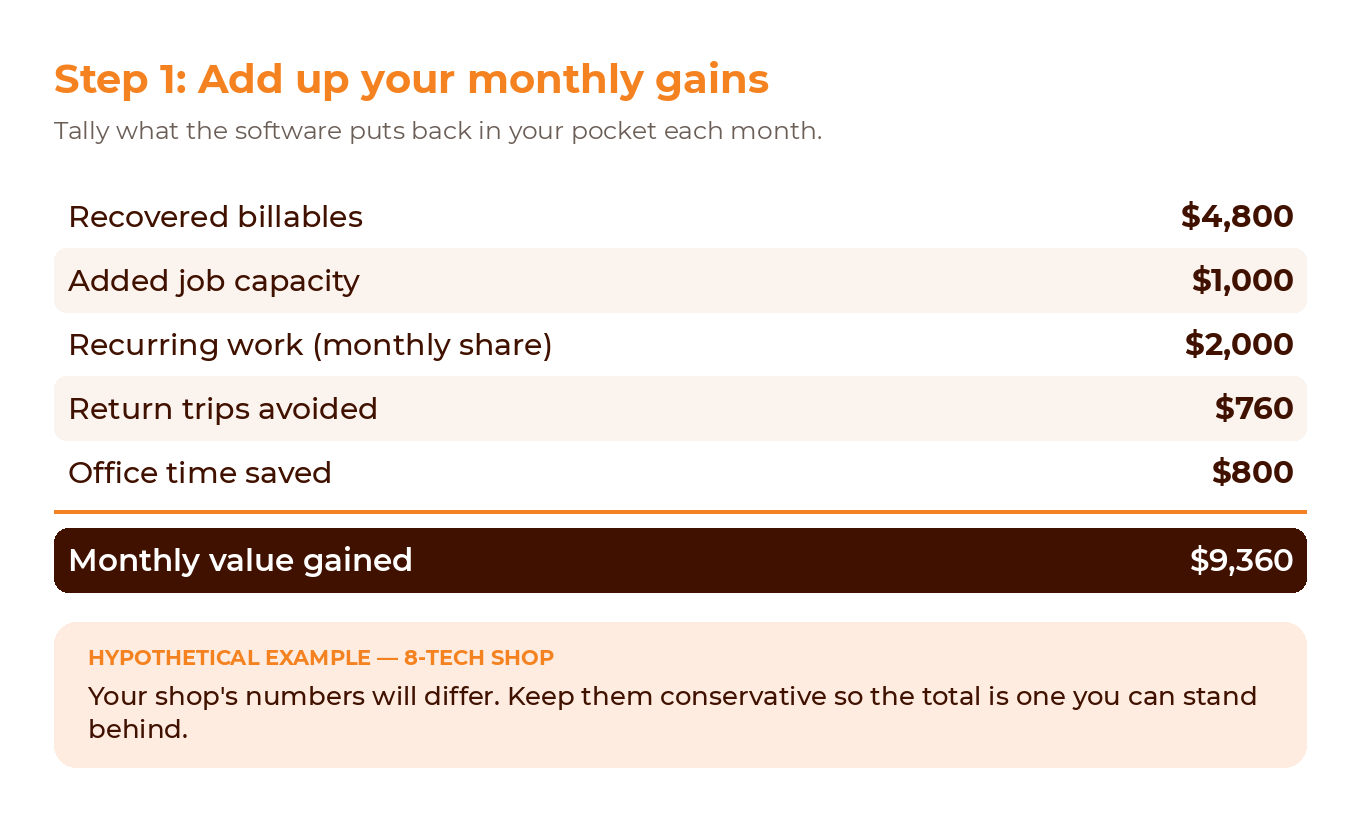
Step 1: Add up the annual value the software creates
Pull your own real numbers for each line that applies to you. A practical starting set:
More jobs completed. Extra jobs per technician per day × average profit per job × working days × number of technicians.
Think of it this way. Faster and cleaner invoicing will get you paid sooner, so you spend less time financing your own receivables and avoid missed invoices that may have fallen through the cracks.
Fewer repeat visits. Repeat trips avoided per month × fully loaded cost of a truck roll (fuel + labor + vehicle) × 12.
Admin time saved. Office hours saved per week on re-keying, chasing details, and reconciliation × loaded hourly cost × 52.
Retention and repeat business. Additional recurring or repeat revenue from better follow-up and maintenance agreements (estimate conservatively).
Step 2: Find your payback period
If you'd rather think in months than percentages, you can calculate a payback period by using the following formula:
Payback period (months) = Annual software cost ÷ (Annual value gained ÷ 12)
This should typically be a few months, not years, before you begin to see the value back for your investment in FSM software.
Use a basic scorecard to keep track
Proper FSM software will help you generate ROI across multiple areas of your HVAC, plumbing, or electrical business. By using a simple scorecard, you can check in on these areas every week or bi-weekly, to see if you’re tracking towards some of the main benefits that can move the revenue needle for you in the short-term.
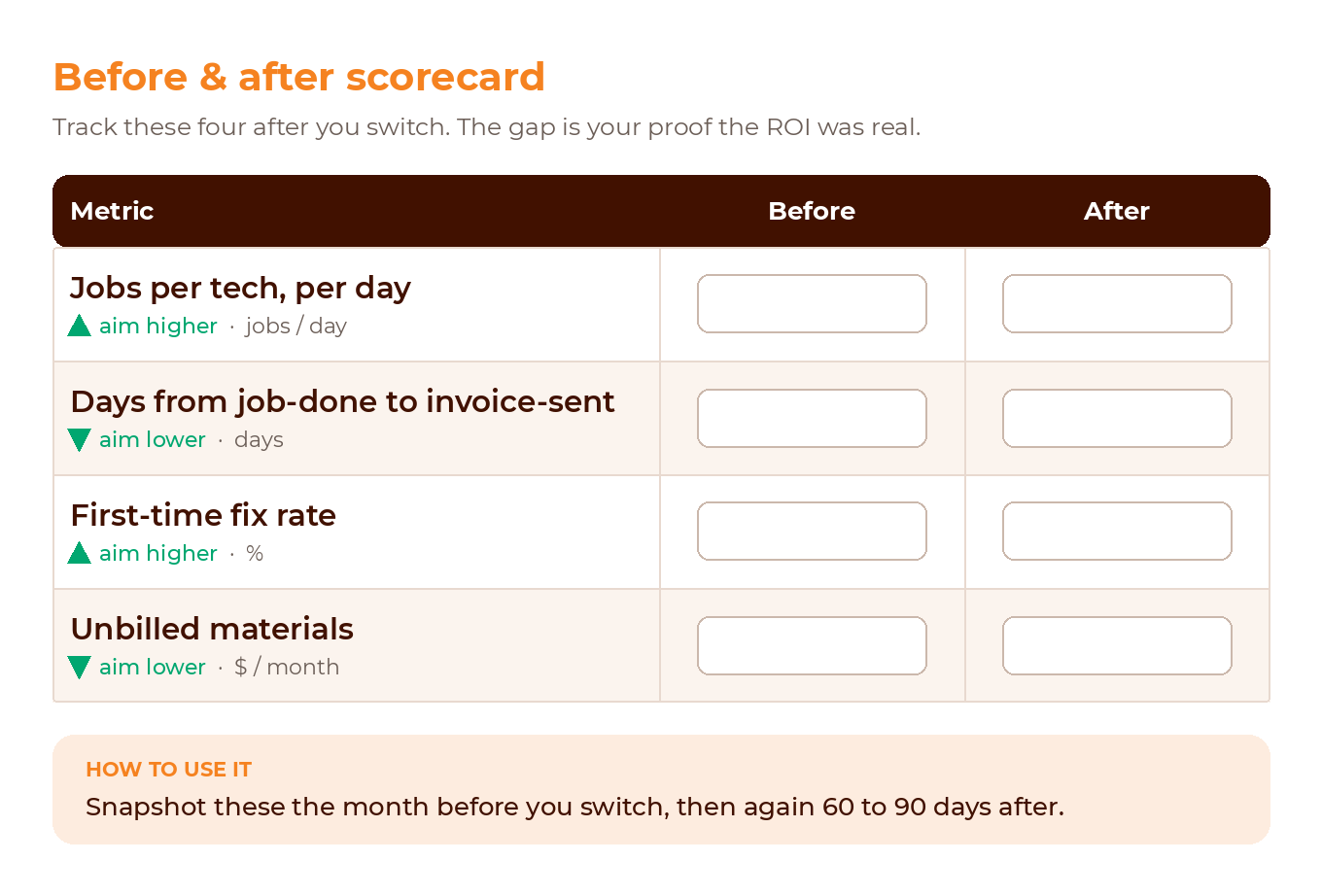
Keep in mind, this may not capture all the ROI and value that software provides, but it offers a quick check-in on some tangible areas we can measure immediately.
Recommended Resource: The Pros & Cons of All‑in‑One Field Service Software
Frequently Asked Questions
What is a good ROI for field service software?
Unfortunately, there is no benchmark for ROI on most software for your business, especially in HVAC, plumbing, and electrical. However, we typically see clients have an easy 10X return within their first year.
The empowerment, reduced admin work, increased cashflows, job flows, and other benefits truly provide an ROI that most other software in your business can’t even compete with.
See how Croft Electric grew their company by 25% in a short period with an FSM Software like ServiceBox.
What's the biggest source of ROI?
For most businesses, it's completing more jobs without adding headcount, because that benefit multiplies across every technician. This is why it was the first benefit we listed: it helps empower your technicians, dispatch, and salespeople to get more jobs on the calendar without burning people out or adding headcount immediately.
Do I need to be a large company to see a return?
The best part about software like this is that you can start seeing returns even if you manage just a few technicians yourself, all the way up to multi-location shops with 50+ technicians.
Recommended Resource: How To Grow Your Plumbing Business in a Competitive Market
Final Thoughts
The ROI of field service management software doesn't come from any single feature. It comes from closing gaps that can take hours to address manually using spreadsheets and even additional headcount.
If you’re curious about how field service software can help generate ROI for your business, book a demo with our solutions support team, and they can help you based on your specific business and scenario.


![How to Schedule Visits for HVAC Systems [Seasonal Maintenance Guide]](https://cdn.prod.website-files.com/67ae6e3fa71598c124af0f8b/6ab5b39ad7006a6e8dd23304_Dispatch%20team.jpg)