
Thinking about franchising your business? Growth is often treated as a straightforward goal for commercial service companies: add new technicians, open new branches, take on more work. In reality, this approach only works for so long. As operations expand, the failure points increase. Cracks begin to form, communication slows, consistency slips, and leaders spend more time managing complexity than moving the business forward.
We want to help! Learn the many ways to structure your potential franchise and mitigate the growing pains that inevitably arise.
Franchising provides a structured model where key systems and processes are already established. If you’re wondering whether your business is ready to scale and whether franchising is the right path, this guide will help you understand what goes into building a franchise model that works for your company.
What is Franchising and Is it Right for My Commercial Service Business?
Is your business performing consistently? Is demand increasing outside your current serviceable area? Is your office running like a well-oiled machine (well, most of the time)? This could be the right move for you.
You may be receiving regular inquiries from nearby cities where customers already recognize your brand and service standards. Your pricing, workflows, and quality expectations are clearly defined, and jobs are delivered consistently regardless of the assigned team. In this situation, franchising allows you to expand into new territories by replicating a proven operating model rather than opening and managing each new location yourself.
A franchise is a business model in which an individual operates a location under your brand, systems, and training. Franchisees gain access to your processes, marketing tools, and support, helping them launch faster and operate with greater confidence. Franchising is a well-established growth model, and franchised businesses tend to have lower failure rates than independent startups, primarily due to standardized systems, training, and operational support. Clear internal systems for scheduling, dispatching, and job management ensure franchisees can replicate success from location to location.
Demand for reliable commercial HVAC, plumbing, electrical, or other field service work continues to grow, with the HVAC industry generating approximately $17.3B in Canada and over $156B in the U.S, driven by ongoing service requirements, steady customer demand, a shrinking skilled labor pool, and growing expectations for faster, more professional, tech-enabled service. Many of the field service trends driving commercial growth in 2026 reflect these same pressures, as service businesses invest more heavily in digital systems, automation, and standardized operations to keep up with demand.
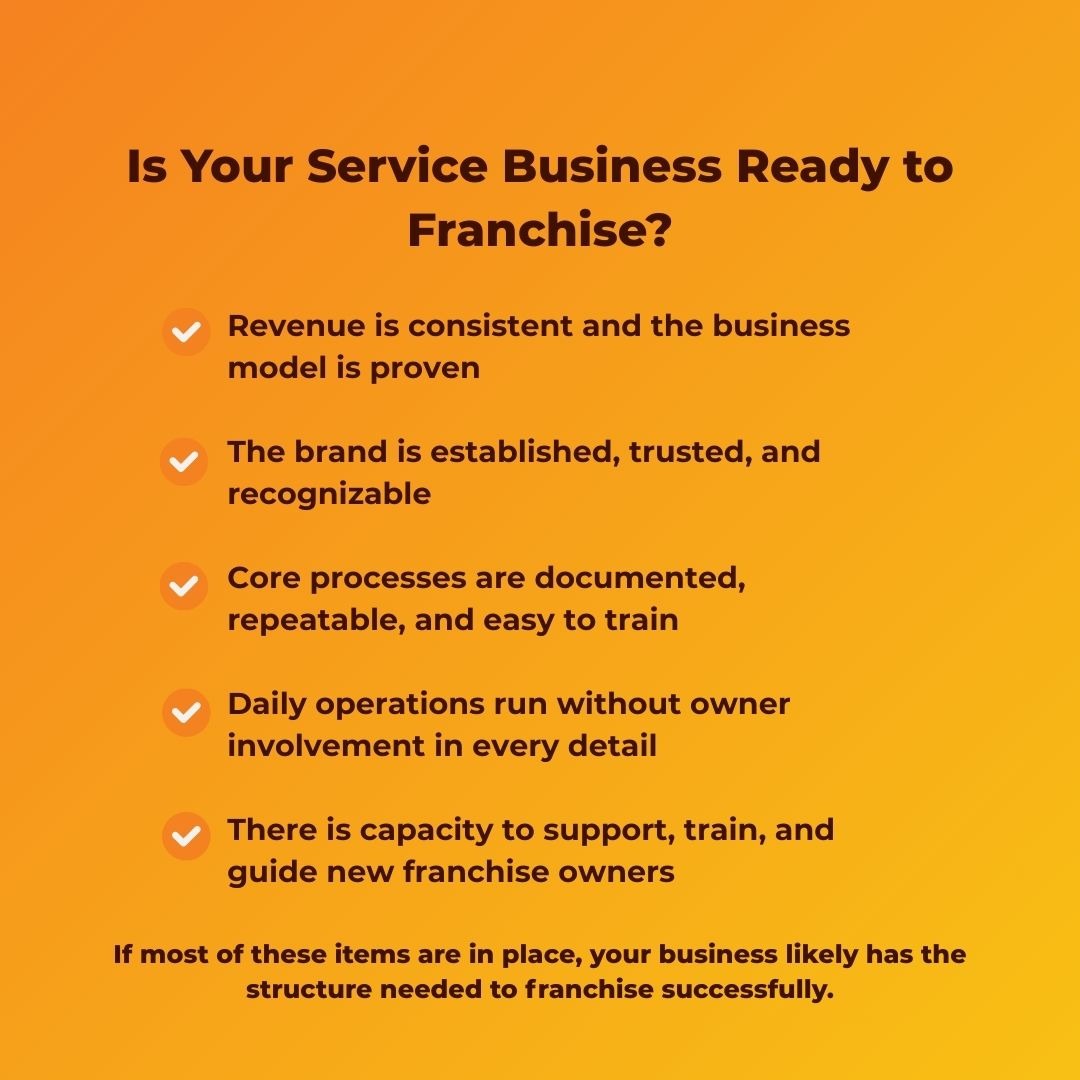
With these trends shaping the industry, many FSM owners are asking whether their businesses are ready to franchise. Here are some signs that indicate your business may be ready:
- You have consistent revenue and a reliable business model
- Your brand has a good reputation and is recognizable
- Your processes are consistent and teachable
- Your business can run smoothly without you being involved in every detail
- You can provide ongoing support to new owners
These indicators often suggest that your company has the stability and structure needed to franchise successfully.
When You May Not Be Ready to Franchise
It is also important to recognize when a business may not be ready to franchise. Franchising can expose operational gaps, especially in pricing consistency, documentation, and leadership structure. Businesses that rely heavily on owner involvement or informal processes often need additional groundwork before expanding.
When your business is NOT ready to franchise:
- Revenue is inconsistent, or margins aren’t predictable
- The owner is required for day-to-day decisions
- Processes are undocumented or handled informally
- Pricing is inconsistent across jobs or customers
- Training is ad hoc rather than repeatable
- Leadership roles and accountability are undefined
- Compliance and licensing aren’t systematized
- Unit economics rely on owner labor
- Technology systems are fragmented
- You haven’t proven the model across multiple locations
Industry Specific Franchising Tips
When planning a franchise strategy for a commercial field service management business, it’s important to consider how your specific trade impacts scalability and long-term success. Industries such as HVAC, electrical, plumbing, and mechanical services are well-suited to franchising, but each requires clear operational standards to scale effectively.
In electrical and plumbing businesses, safety compliance, licensing, and regional code requirements must be built into training and daily workflows. Defined standards for estimating, job documentation, and quality control help franchisees operate consistently while maintaining brand integrity. Explore how plumbing dispatch software can streamline operations as you scale.
Across all field service industries, strong operational systems are essential to scalable growth. Standardized onboarding, repeatable service workflows, and clear quality controls ensure a consistent customer experience across locations and reduce reliance on individual operators as the network expands.
Technology also plays a strong role in supporting franchise networks. Integrated FSM platforms connect scheduling, job data, customer information, and invoicing all in one place, helping franchises reduce manual work, improve billing accuracy, and speed up payments. Streamlined invoicing and connected systems are especially important as networks grow, as they improve cash flow and provide both franchisors and franchisees with clearer visibility into financial performance. This reduces manual work, improves billing accuracy, and provides better visibility into performance and cash flow across the franchise network.
Good practical tips
- Pilot your “franchise” internally first, using a new location or management layer
- Document everything before legal work, not after
- Assume support demand will be higher than you expect in year one
- Build disqualification criteria for franchisees early
- Treat franchising as a product, not a sales channel
ServiceBox provides the field service management infrastructure that keeps scheduling, reporting, and invoicing connected as you grow from one location to many. Book your demo today to get started.
Building Your Franchise Development Strategy
Developing a franchise strategy begins with deciding which franchise model aligns with your growth goals, operational capacity, and brand vision. Your development strategy should outline your ideal franchisee, territory sizes, expected unit-level performance, and fee structure, including franchise fees, royalty fees, and marketing fund contributions. A clear financial model ensures profitability for both franchisor and franchisees.
There are several standard franchise models to consider, each supporting different growth strategies:
- Single-Unit Franchise: One franchisee operates a single location; simple and easy to control.
- Multi-Unit Franchise: One Franchisee operates multiple locations; supports faster growth.
- Area Development Franchise: A franchise commits to opening multiple locations in a region over time.
- Master Franchise: Franchisee manages a large territory and can recruit sub-franchisees.
Once you’ve chosen the franchise model that fits your business, the next priority is to build the legal and operational infrastructure to support your franchisees. This includes preparing your Franchise Disclosure Document (FDD) if you plan to operate in the US. The FDD outlines the structure of your franchise system and sets clear expectations for prospective franchisees. It covers your company background, franchise fees and ongoing royalties, territory rights, training and support programs, and the obligations of both the franchisor and the franchisee. For operations, the FDD serves as the core document, ensuring compliance, transparency, and alignment as the franchise grows.
A few things people forget to consider
- You haven’t defined what success looks like for a franchisee
If you can’t clearly describe what a “healthy” franchise looks like at 6, 12, and 24 months, you’re not ready to support one. - Brand standards aren’t enforceable
If you don’t have the appetite or systems to correct underperforming or off-brand franchisees, franchising will damage the brand you’re trying to scale. - You haven’t decided how much control you actually want
Many founders say they want scale but emotionally resist standardization. Franchising requires letting go in some places and tightening control in others. - Your support model isn’t priced into the business
Training, onboarding, escalation, and audits cost real money. If royalties don’t cover support without resentment, problems follow. - You haven’t stress-tested your systems
Processes that work well in good times often collapse under volume, staff turnover, or seasonal spikes. Franchises expose that fast. - Franchise conflict resolution isn’t defined
If you don’t have clear escalation paths, remediation steps, and exit mechanisms, small disputes can become expensive.
- Franchisees ask more questions than employees.
A lot more. If you don’t have documentation and self-serve resources, leadership becomes the bottleneck.
Systemizing Operations for Scalability
Scaling a franchise depends on having clear, consistent systems that every location can follow. Your operations should be documented so new franchisees can learn and deliver the same level of service your company is known for.
Key areas should include:
- Documenting proven processes
- Quality control mechanisms
- Supply chain and vendor management
- Brand consistency standards
- Field support and ongoing training
Together, these systems form the operational foundation that allows a franchise to grow while maintaining quality and consistency across the entire network.
Financing Growth and Unit Economics
A successful franchise strategy requires careful financial planning to support both long-term growth and day-to-day sustainability. Understanding the financial structure on both the franchisor and franchisee sides helps ensure the model is profitable and realistic as the network expands.
Financial planning areas to consider:
- Capital requirements: Legal setup, marketing material, training resources, support staff, and required technology
- Revenue Models: Franchise fees, ongoing royalties, marketing fund contributions, and product or service margins
- Returns and break-even: Typical break-even times range from 6 to 18 months based on service mix and recurring revenue
- Startup operating costs: Budget for staffing, marketing, equipment, and inventory during the early expansion phase.
Making The Decision
Franchising can be an effective growth strategy, but it isn’t the right fit for every FSM business. Before moving forward, it’s important to evaluate whether your company has the structure, resources, and long-term goals needed to support a franchise network.
Use the checklist below to assess your readiness:
- Revenue is consistent, and the business model is proven.
- Core processes are documented and easy to teach.
- The business runs well without daily owner involvement.
- The brand is trusted and clearly defined.
- There is the capacity to train and support franchisees.
- Unit economics work for both franchisor and franchisee.
- Systems and technology can support multiple locations.
If most of these boxes are checked, franchising may be the right move for your company. If several areas still need development, this checklist can serve as a roadmap for strengthening them before pursuing expansion. Addressing gaps early makes scaling easier while protecting operational performance and brand reputation.
Final Thoughts
Franchising can be a strong growth strategy for commercial FSM companies, but success depends on preparation. A strong franchise is built on a proven business model, clear unit economics, documented systems, and the ability to support franchises as the network expands.
Recurring service work and steady demand make franchising a natural fit. Choosing the right franchise model, developing a strategy, and systematizing operations are essential to scaling without sacrificing quality. With the right technology in place, franchise networks can maintain visibility, consistency, and financial clarity across locations, making growth more manageable and sustainable.
Growth works better when everything is connected. Book a demo to see how ServiceBox supports centralized field service operations.


![How to Schedule Visits for HVAC Systems [Seasonal Maintenance Guide]](https://cdn.prod.website-files.com/67ae6e3fa71598c124af0f8b/6ab5b39ad7006a6e8dd23304_Dispatch%20team.jpg)